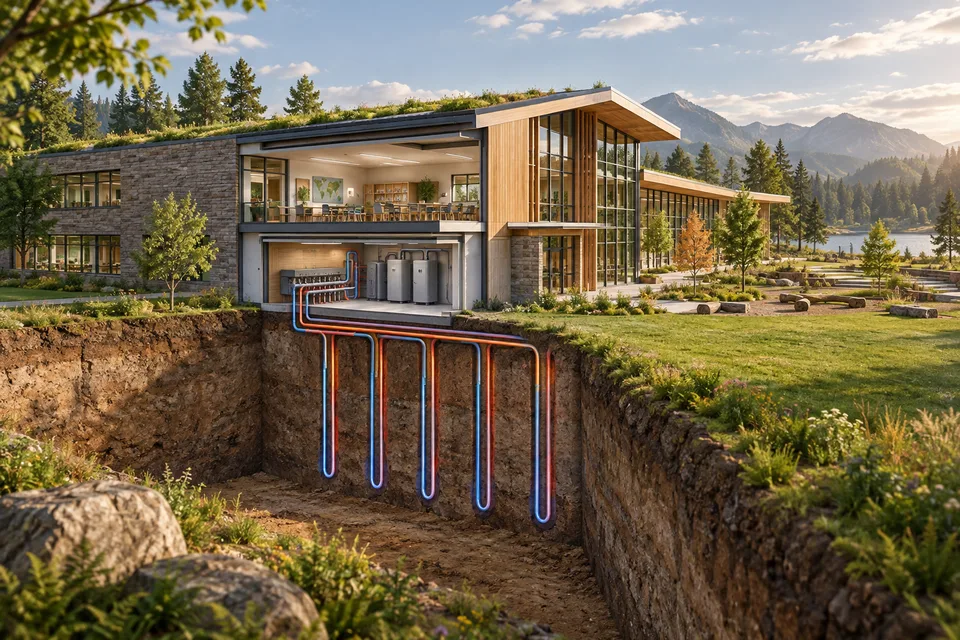
Draw a building in section. Below it, pipes exchange heat with the ground; inside it, a heat pump moves heat between that loop and the rooms. The drawing is a useful introduction. It becomes misleading if the ground is treated as an unlimited source at an unchanging temperature, unaffected by what the building repeatedly takes or returns.
Ground-source heat pumps can exploit relatively stable subsurface conditions. They still use electricity, require an appropriate heat-exchange design and operate within a site-specific thermal environment. Their appeal does not depend on ignoring those constraints. Understanding the constraints is what makes a dependable installation possible.
The US Department of Energy’s geothermal heat-pump explanation describes a ground heat collector, heat pump and distribution system, with horizontal or vertical loop arrangements. This is distinct from assuming every project taps a high-temperature geothermal resource suitable for generating electricity. The useful local resource may be a moderate-temperature environment from which heat is moved, rather than a source of ready-made steam.
Winter: heat leaves the ground
During heating operation, the system extracts heat through the ground-side arrangement and supplies useful heat to the building through the heat pump. The compressor and supporting equipment need energy. The relationship between useful output and electrical input depends on the whole operating configuration, including the temperatures at which the system has to work.
The building’s demand therefore belongs in the design. A draughty envelope or a distribution system requiring a different delivery temperature can change the task the heat pump must perform. A borehole specification cannot by itself establish how the occupied building will behave. The ground system and the building-side work need to be assessed together.
The extraction also has a history. A brief cold period is different from repeated seasons in which heating dominates the annual load. Heat can move through the surrounding ground, but its response is not instantaneous or identical at every site. The design needs to consider the expected pattern over time rather than treat the initial ground temperature as a permanently available condition.
A 2025 review of hybrid ground-source systems identifies thermal imbalance and investment cost among the issues motivating hybrid designs. Its scope includes combinations with other technologies and operating strategies. That is a reason to examine the design and conditions, not a finding that every ground-source installation necessarily suffers unacceptable drift.
Summer: the direction can reverse
In cooling operation, heat removed from the building can be rejected through the ground-side system. That can complement winter extraction, but the annual balance should be established rather than assumed. A building with heavy cooling demand and little heating demand has a different pattern from one dominated by winter heating.
Neither the presence of four seasons nor a balanced-looking drawing guarantees thermal balance. Occupancy, internal equipment, operating hours and the building’s use affect its loads. A school, apartment building and continuously operated commercial facility may need different things at different times. Their calendar is part of the engineering input.
Equal building loads need not balance the ground loop. Using the heat-pump and refrigeration energy relationships explained by OpenStax, take an explicitly idealized example with a heating coefficient of performance of four and a cooling coefficient of four. Delivering 10 MWh of heat requires 2.5 MWh of electrical work and extracts 7.5 MWh from the ground. Removing 10 MWh from the building during cooling requires another 2.5 MWh of work and rejects 12.5 MWh to the ground.
The building’s heating and cooling quantities are equal, yet the ground receives 5 MWh more than was extracted in this calculation. Pumping, auxiliary equipment and site heat exchange are omitted. The example does not predict a borefield’s temperature drift or prove that a net input is unacceptable. It shows why balance must be examined at the ground boundary, with the electricity and surrounding thermal response included, rather than inferred from equal building-side totals.
Hybrid arrangements can introduce other heat sources or sinks where they are justified. Those additions have their own equipment, costs and operating requirements. A proposal should identify why they are included and what they contribute, instead of describing the ground loop as self-sufficient while relying on another component to maintain its usable conditions.
The borefield is a design, not a hole count
Borehole depth, arrangement, spacing, construction and the surrounding ground affect how the field exchanges heat. Counting holes without the relevant design can produce a poor comparison. Two sites with the same count need not have the same thermal capability, just as two sites with the same nominal building load need not require identical fields.
The installation also occupies a physical site. Drilling access, existing buried services, available surface area and applicable permissions can influence what is practical. These constraints are not evidence against the technology; they are the conditions under which a specific project must be built. A diagram drawn without them can make a retrofit look simpler than the work required.
Thermal-response measurements and other appropriate investigations can inform a design, but a test has a scope. The engineer needs to interpret what was measured, where and under which conditions. A favorable result at one location is not a universal ground property for every nearby site, nor does it settle the building’s future load profile.
The long-lived underground field and the building’s mechanical equipment may also have different maintenance and replacement cycles. A project needs a record that future operators can use when equipment is changed. Losing the assumptions and layout beneath a succession of building owners makes later decisions harder even if the original installation was well designed.
When several buildings share the loop
A network can connect buildings to shared thermal resources. Different demands may create opportunities to exchange heat or make better use of infrastructure. That possibility depends on timing, temperature and the network design. Adding buildings does not automatically mean their demands cancel in the useful way a schematic suggests.
Framingham, Massachusetts, provides a concrete project to follow. A 2026 study of its planned Flagg-loop expansion describes an existing Concord loop operating since summer 2024 and an expansion designed to connect to it. The paper gives a tentative spring 2027 construction start for the expansion, pending regulatory approval. The planned addition should not be described as an already completed operating network.
The study examines issues including borefield configurations, connections between loops, thermal modeling and ownership demarcation. Its authors include project participants, so it is useful firsthand design evidence with an identified perspective. It does not establish that every community would achieve the same outcome or that planned performance has already been measured.
The network introduces an important distinction between the sum of individual building peaks and the load occurring simultaneously on the shared system. Those peaks need not coincide. The relevant resource requirement also reflects how heat pumps and the network exchange energy. A claim about network size should say which measure it represents before the number is used to compare projects.
HEET’s Measurement Matters memo and technical note proposes separate building and network load measures and explains why Framingham project comparisons can become misleading. Among the issues it identifies are different load bases, borehole designs and cost scopes across phases. Its proposed measures are a participant organization’s contribution to standardization, not a universally adopted rule that every existing project already follows.
This makes measurement a practical ownership issue rather than an academic detail. A customer wants dependable heating and cooling. A network operator needs to know the coincident duty its infrastructure must meet. A comparison of investment needs a consistent denominator. Using the largest convenient number for each purpose can make the same project look larger, cheaper or more efficient without changing the physical system at all.
What does the efficiency number include?
A heat pump’s measured performance can describe the equipment under specified conditions. A network-level measure may include a different set of electrical inputs, thermal exchanges and supporting components. Both can be useful, provided the boundary is visible. An impressive equipment coefficient should not silently become the reported efficiency of every part of the installation.
The same caution applies to peak electricity demand. A system can reduce a building’s electrical requirement relative to one alternative without proving the same reduction relative to every alternative. The comparison needs the baseline equipment, building conditions and relevant period. A cold-weather claim deserves evidence from the weather and operating conditions it is meant to describe.
Annual averages can also conceal an uncomfortable interval. A system serving most hours efficiently may still need a defined arrangement for peak conditions or equipment failure. The appropriate review combines useful long-term measures with the operating events that matter to occupants. A household experiences the temperature in its rooms, not the annual average plotted in a project presentation.
For a pilot, uncertainty can be productive if it is measured and reported. The purpose is partly to learn what assumptions were sound and what needs changing. Reporting only the most favorable period turns a learning project into a promotion exercise. Reporting every early adjustment as proof that the concept failed is equally unhelpful.
Who owns the line between the street and the room?
A shared thermal network needs a clear division of responsibility. Who operates the loop, who owns the heat pump, who maintains building-side distribution and whom does a customer contact when the room is not receiving the promised service? A technically elegant network can still provide a frustrating experience if each party believes the problem belongs to another component.
The June 2026 RAP and HEET report on thermal-network regulation addresses the emerging service model, recommending reliability standards, simple initial rates and rigorous data collection during demonstrations. It also considers how regulation should develop as networks mature. These are the report’s policy recommendations, not a statement that all jurisdictions currently impose the same framework.
Customers need to understand the actual offer. A network charge may cover one part of the service while electricity for building equipment appears elsewhere. A meaningful bill comparison includes the relevant costs on both sides and identifies any subsidy or pilot arrangement. Otherwise, a lower charge on one line can be mistaken for a lower total cost.
Future connections raise another allocation question. An extension can benefit from existing infrastructure while creating new loads or requiring reinforcement. The agreement needs a fair way to allocate those responsibilities and protect existing service. The physical opportunity to add another loop does not itself settle who should pay for it or what existing customers have agreed to support.
The buildings remain important after connection. Changes in use, occupancy or equipment can alter demand. The operator needs an appropriate process for understanding significant changes, and customers need an intelligible route for proposed alterations. A system planned as a long-term service cannot depend forever on the load assumptions of its first design drawing.
Read the ground and the agreement together
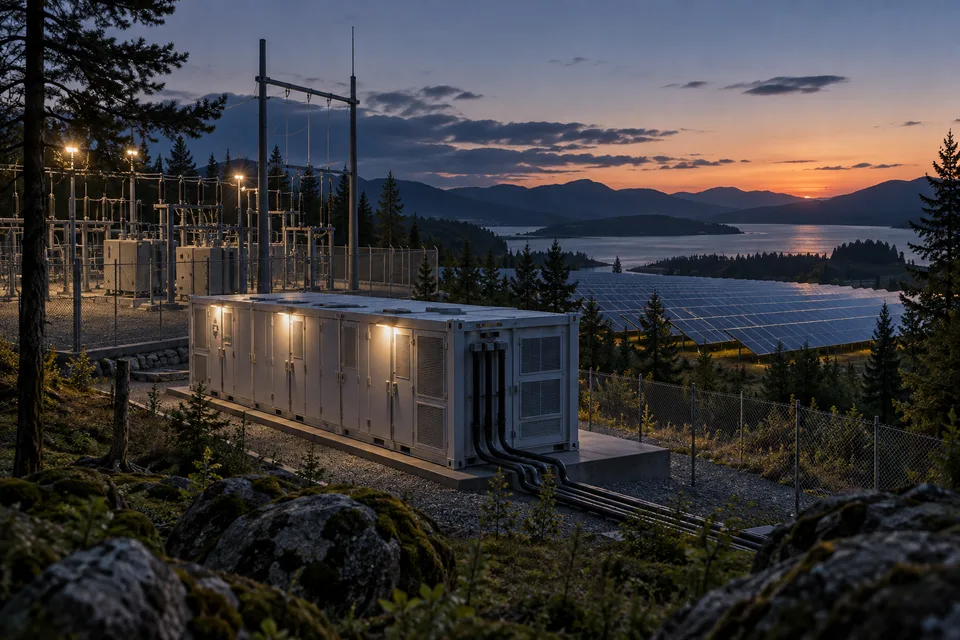
The conceptual cross-section can now include the missing information: expected seasonal flows, relevant ground evidence, the building’s required service and the operating boundary. For a network, add the coincident load and the division of ownership. These details turn a promising principle into a project that can be evaluated.
They also identify what a pilot must establish before another community copies it. A successful route is not simply a particular borehole depth or a reported coefficient. It is a fit between resource, load, construction, controls and service responsibilities, under conditions that can be described and compared. Some features may transfer; others need to be designed again for the new site.
The installation leaves two records worth keeping together: the ground’s thermal response through the seasons, and the agreement assigning costs and maintenance to the people sharing the loop. One helps reveal whether the physical balance is behaving as designed. The other determines whether a problem can be addressed when it appears. A successful ground-source project has room for both on its operating desk, long after the boreholes disappear beneath the finished landscape.
Sources & context
This article draws on the sources linked in the text. Analysis and illustrative scenarios are identified separately from reported findings.
- US Department of Energy's geothermal heat-pump explanation
- 2025 review of hybrid ground-source systems
- heat-pump and refrigeration energy relationships explained by OpenStax
- 2026 study of its planned Flagg-loop expansion
- Measurement Matters memo and technical note
- RAP and HEET report on thermal-network regulation