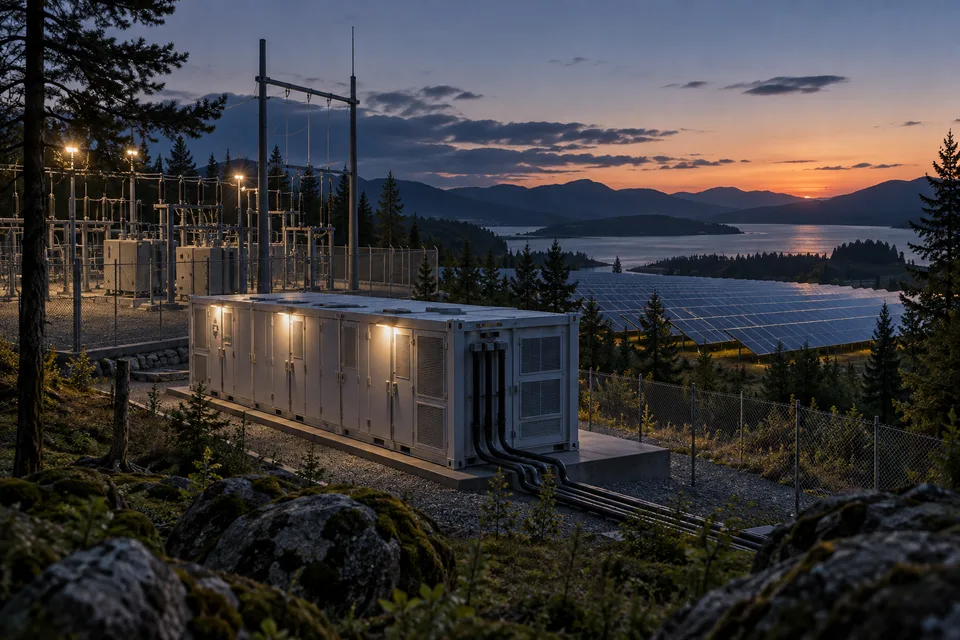
In November 2025, Rondo Energy announced an agreement with EDP and HEINEKEN for a 100 MWh heat-battery installation at a brewery and malting plant in Portugal. The proposed service was steam for industrial processes, charged using electricity from on-site solar and the grid. The announcement describes a contracted project and its intended performance. It is not an independently verified operating record.
The project nevertheless points to an important distinction in the storage debate. The customer needs heat, not a container full of electrical charge. Once that end use is explicit, a different set of storage options becomes visible: water, ice, solid materials and other systems that hold thermal energy for later use.
Calling such a system a battery can help explain its role across time. It can also conceal differences from an electrical battery. A heat store does not necessarily return electricity. Its value depends on delivering the required thermal service at an appropriate temperature and rate, when the user needs it. The useful question is where heat belongs in the whole energy pathway.
Before the store: identify the final demand
A building may need hot water, space heating or cooling. An industrial process may need steam or heat at a much higher temperature. These demands cannot be treated as interchangeable quantities merely because all can be measured in energy units. Their temperature requirements and delivery arrangements are part of the specification.
For a low-temperature building demand, a heat pump may move heat from an available source and raise it to a useful temperature. The US Department of Energy’s heat-pump explanation describes moving heat using electricity. A system’s actual efficiency depends on its configuration and conditions; a fixed multiplication factor should not be attached to every installation.
For a different industrial demand, electrical resistance or another heating process may supply the required thermal conditions. The choice belongs to the actual process, available energy and engineering requirements. A successful building-scale demonstration should not be promoted as proof that an identical arrangement serves every industrial temperature, just as an industrial installation does not automatically provide a practical household product.
Define the demand over time as well. A process operating continuously needs a different delivery schedule from one that runs in batches. A building’s peak requirement can be concentrated in particular hours. Storage is useful when its charging and discharge opportunities fit those patterns, not because storing energy is inherently valuable regardless of when it will be used.
During charging: make the temperature useful
Thermal storage can involve raising a material’s temperature, using a phase change or exploiting other physical processes. The Department of Energy’s thermal-storage program describes storing a heat source or cold sink for later use. Its scope includes integration with building equipment and controls, emphasizing that a storage material becomes useful through a system.
A hot-water tank makes the idea familiar. Heat is added and retained until water or an appropriate heat exchanger supplies a later need. The usable result depends on temperature levels, losses and how the system transfers energy. A large tank at an insufficient temperature can contain substantial thermal energy while being unable to deliver a particular process requirement directly.
Cooling storage uses the same timing idea from the other direction. Ice or another appropriate medium can be prepared earlier and later absorb heat as it warms or changes phase. The service is cooling delivered when needed. Describing it as stored cold can be convenient, provided the explanation does not lose sight of the actual flow of heat.
Charging also interacts with the electrical connection. A store that needs to absorb substantial energy in a short inexpensive period may require a correspondingly capable supply and charging system. Moving consumption away from a later peak can still create a concentrated earlier load. The grid benefit needs an operating schedule, not an assumption that any storage automatically reduces every network requirement.
While waiting: capacity has a temperature boundary
The material holds energy across an interval, but not without conditions. Heat can move through insulation, and the usable temperature can change. The significance of that loss depends on the duration, surroundings and end use. A quantity remaining in the store may be less valuable if its temperature no longer meets the task’s requirement.
This is why an energy-capacity figure needs its relevant temperature range. Comparing capacities calculated over different ranges can exaggerate a difference between systems. A product claim should make it possible to understand what portion of the stored energy can be delivered as the service the buyer actually needs, rather than only how much energy the material could theoretically hold.
Material properties do not settle the device’s performance. The 2021 Nature Energy paper Rate capability and Ragone plots for phase change thermal energy storage examined the relationship between energy and power performance, including the effects of geometry and operating conditions. It supplies a framework for evaluating devices, rather than a universal ranking of every material by one laboratory property.
The practical implication is straightforward: how much can be stored and how quickly useful heat can move in or out are connected design questions. A compact material with an attractive nominal capacity may need a carefully engineered heat-transfer arrangement. The resulting system can occupy more space or have different costs from a comparison based on material alone.
Maintenance belongs within this waiting period too. Insulation, pumps, valves, controls and other components need an operating arrangement appropriate to the design. A simple-looking storage medium does not imply that the complete installation has no service requirements. The comparison should count the machinery that makes the stored energy accessible.
At discharge: the product is a service
The receiver needs a particular combination of temperature, rate and reliability. Reaching the total promised energy eventually may be inadequate if the process requires a defined flow now. Conversely, an installation capable of a high brief output may not sustain a longer requirement. The full delivery profile matters more than either maximum number in isolation.
An imagined water tank makes the temperature boundary calculable. Assume 10,000 kg of uniformly mixed water and approximate its specific heat as a constant 4.186 kJ per kilogram per degree Celsius, using the textbook value listed by OpenStax. This is an idealized calculation: actual specific heat varies with temperature, and tank, pipe and transfer losses are excluded.
Heating that water from 20°C to 60°C stores about 465 kWh relative to the 20°C reference: mass times specific heat times the 40-degree difference, converted from kilojoules. Now assume the receiving process cannot use water below 40°C in this arrangement. Cooling from 60°C to that cutoff makes only about 233 kWh available above the required threshold in the simplified model. There is still energy relative to 20°C; it is no longer the same directly usable service.
A heat exchanger would need its own temperature margin, and a stratified tank would not follow this uniformly mixed model. The example is not a tank design. It explains why two capacity claims can differ even before insulation loss enters the discussion: one counts a larger temperature interval than the user’s process can exploit. Neither quantity is electricity available to unrelated equipment.
This is where some storage comparisons go wrong. Electrical storage can supply many electrical uses, while a thermal store is often closely matched to a particular thermal service. The thermal option may be attractive precisely because it avoids conversions the end use does not need. The electrical option’s flexibility may be valuable in a different job. Neither advantage should be erased by forcing both into a misleadingly identical product description.
The Portugal brewery announcement should be read in that spirit. Its proposed capacity and steam service describe an industrial arrangement, not an electrical battery that a household could use interchangeably. Assessing the eventual project would require the actual charging profile, delivered steam conditions, supporting equipment and operating evidence. A press-release capacity cannot supply those missing records.
Back around the loop: electricity still has a source
Storing heat can shift when electricity is consumed. It does not automatically establish that the electricity is low carbon or that shifting reduces emissions in every circumstance. The relevant supply, timing and comparison matter. A clean-energy claim needs an account of those conditions rather than relying on the storage medium to carry the entire environmental argument.
The same is true of cost. A lower charging-period electricity price can create an opportunity, but the project also has losses, connection needs, capital costs and an operating schedule. The avoided alternative matters: another electric system, a fuel-fired boiler or a different process can each produce a different comparison. A headline saving without that baseline is difficult to interpret.
Controls determine whether the intended opportunity is actually used. A store might be technically capable of shifting demand while an unsuitable control strategy charges it at an unhelpful time. A building might preserve comfort with a well-integrated thermal system or experience problems if the store and the heating equipment work against one another. The installation needs an accepted sequence of operation, not merely compatible components on a diagram.
The Department of Energy’s Stor4Build initiative treats materials, controls, equipment integration and test procedures as related research areas. That framing is useful because the barriers are not confined to discovering a new storage substance. A deployment also has to fit the building, operator and electricity arrangement in which it will work.
The ownership question inside the pipework
The person paying for equipment may not be the person paying the energy bill or managing peak demand. A landlord, tenant, industrial operator and electricity provider can value different parts of the same installation. A technically promising project can stall if the benefits and responsibilities are divided in ways the agreement does not address.
Service-based arrangements can allocate some of those responsibilities differently from an outright equipment purchase. The brewery announcement describes a heat-as-a-service approach. That label still needs a specific agreement: what service is supplied, how performance is measured, which party maintains equipment and what happens when the demand changes. The commercial form is part of the project, not a guarantee of a good outcome by itself.
Retrofits add physical constraints. Space, existing distribution equipment, planned maintenance windows and access for installation can all affect feasibility. A storage option that works well in a new design may be awkward in a building arranged around an existing system. The right comparison includes integration work rather than treating the storage vessel as the entire installed cost.
The evaluation should also identify the fallback. If the store cannot provide the required service, does another system take over, does the process stop or does the operating schedule change? These choices influence reliability, cost and environmental claims. A backup retained for rare use belongs in the description even when it supplies little energy during an ordinary week.
Measure the heat that does useful work
A project review should distinguish charging energy, storage losses, delivered thermal energy and the conditions of delivery. It should show whether the end use received the service required and whether the intended demand shift occurred. A high storage efficiency is valuable evidence, but it is not a complete evaluation of the whole building or industrial process.
Comparison periods need care too. Weather, production volume or occupancy can change demand. A lower energy bill after installation does not by itself identify how much of the change came from storage. The measurement plan should record the relevant operating context and compare against a defensible baseline, rather than attribute every favorable movement to the new equipment.
For the wider energy system, the opportunity is substantial in concept: many useful outputs are thermal, so not every unit of stored energy has to return as electricity. The limit is equally important: heat has a location, a temperature and a receiver. A store that fits those conditions can be valuable without becoming a universal battery.
The overlooked tank, block or vessel earns attention when the energy pathway is drawn all the way to the user. Start with what the building or factory needs, follow the heat through time and count the service delivered. That makes thermal storage neither a curiosity beside electrical batteries nor a replacement for every one of them. It makes it a technology with a job worth specifying.
Sources & context
This article draws on the sources linked in the text. Analysis and illustrative scenarios are identified separately from reported findings.
- announcement
- US Department of Energy's heat-pump explanation
- Department of Energy's thermal-storage program
- Rate capability and Ragone plots for phase change thermal energy storage
- OpenStax
- Stor4Build initiative