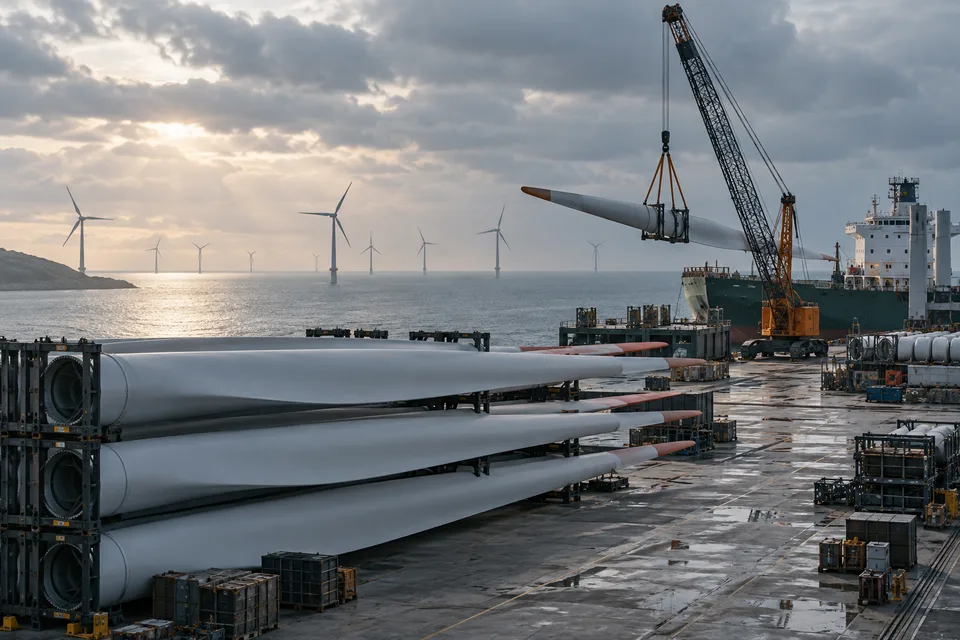
The most important offshore-wind photograph may contain no operating turbine. It may show an empty area beside a quay: land on which large components could be stored, moved and assembled, if the ground can carry them, the water can accommodate them and projects arrive in time to pay for the work.
In March 2026, the UK government announced up to £64 million in support for Port Talbot’s floating-wind development. The stated purpose included essential design and engineering work. This was a development milestone, not evidence that a finished floating-wind assembly port had suddenly entered service. That distinction is central to understanding how offshore capacity becomes buildable.
The wind resource is offshore. Much of the difficulty of using it arrives first on land.
A port is a set of dimensions
An apparently large harbor can still be unsuitable for a particular operation. Quayside length, water depth, storage space, ground-bearing capacity and the route to open water describe different constraints. One generous dimension does not compensate automatically for another that prevents a component or vessel from passing.
The 2023 US offshore-wind supply-chain road map, published by the then National Renewable Energy Laboratory and partners, makes this concrete in its port-screening work. It considers laydown area, quay and channel dimensions, bearing capacity and overhead restrictions. Its screening assumptions concern the report’s scenarios and component needs; they are not a universal certification that a port with a particular acreage is ready for every future turbine.
These constraints explain why expanding a site can be more involved than clearing a yard. A load-bearing surface, an access route and a berth have to function as one operating system. The layout must allow work to happen, not merely allow all components to be placed somewhere on a drawing.
A storage area that is full can also stop an otherwise capable operation. The relevant question is how quickly components arrive, how long they stay and in what order they leave. A port with enough space for one ideal sequence may struggle when delivery dates change. Buffer space is therefore part of a schedule, not simply unused land waiting to be made more productive.
This is one reason not to infer readiness from a map. Publicly visible land can have existing uses, access constraints or engineering requirements that the image does not reveal. A credible assessment needs the actual port and project specifications, with uncertainty retained where investigations are incomplete.
Floating does not mean assembled anywhere
Floating wind changes the relationship between the turbine, its supporting structure and the port. Some installation work can be organized around assembling and integrating systems near shore before they are towed out. That creates opportunities, but also demands on sheltered water, assembly space and the route used by the assembled structure.
ABP’s Future Port Talbot description identifies deep sheltered water, developable land and proximity to the Celtic Sea as strengths of its proposed hub. It also labels its vision image as computer-generated and says the representation will evolve with technology and developer requirements. These are the port developer’s stated plans, not an independent finding that every technical and commercial requirement has been settled.
The changing requirements matter. A port investment may serve several wind projects rather than a single standardized unit. Turbine and platform choices can affect the space, lifting, assembly and water arrangements needed. Designing too narrowly around one early concept can limit later use; waiting for every design to become final can delay infrastructure that needs a long lead time.
The solution is not to assume unlimited flexibility. It is to identify which capabilities are reasonably shared, which are project-specific and which design decisions would be expensive to reverse. A general-purpose promise should be supported by a real operating envelope, just as a turbine’s output claim needs stated conditions.
There are different port roles as well. Manufacturing, staging, assembly, installation support and maintenance need not all happen at one location. A manufacturer needs a workable route for its components; an integration port needs a route for the larger assembled system. In a proposal that tows an integrated turbine out to sea, the route must accommodate that configuration, not just the separate pieces that arrived at the yard. Adequate depth beside a quay cannot, on its own, settle an overhead or channel restriction farther along the exit.
That is a design question to test, not a claim of such a restriction at Port Talbot. A regional plan needs to identify the exact handoffs between its ports, factories and vessels. Concentrating every function at one harbor can add a different constraint instead of removing the original one.
The vessel has its own calendar
Once components leave the yard, a specialized vessel or tow arrangement connects the port schedule to the offshore work. The equipment must suit the task and be available at the right time. A vessel described as existing somewhere in the global fleet is not necessarily available for a particular project’s window.
The US Department of Energy’s 2022 account of supply-chain requirements identified installation vessels, feeder arrangements, cable-lay capability and a trained workforce alongside components and ports. The report addressed the deployment goal and conditions of its time. Its value here is the linked set of requirements, not a claim that its old fleet estimates describe the market in October 2026.
The scheduling problem is easy to underestimate because the hardware looks permanent. A quay remains after the ship leaves, but access to a limited vessel fleet is temporary. If an earlier task slips, the next task may lose a slot. Moving one activity can affect several contractors and projects, rather than simply add the same number of days to one spreadsheet.
Weather adds an operating constraint that cannot be removed by contractual confidence. Different offshore activities have different acceptable conditions, and the detailed limits belong to the equipment and procedure. A project schedule needs a realistic allowance for its work, not a generic statement that the sea is sometimes rough.
Maintenance inherits these logistics. Once a farm operates, equipment access, spare parts, technicians and suitable vessels influence how quickly a fault can be addressed. A long-lived energy asset needs a service route after the construction fleet has moved on. The port’s operating future should be considered before its installation-phase employment is announced as the whole economic story.
A pipeline is a promise with several gates
Port investment and wind-project investment depend on one another. A developer wants confidence that infrastructure will be ready. A port wants confidence that projects will use it. Both face a sequence of consents, contracts, finance and construction decisions. A list of proposed gigawatts cannot resolve this coordination problem on its own.
Scotland’s Supply Chain Development Statements show an effort to make anticipated demand more visible. Crown Estate Scotland’s July 2026 information describes submissions and updates, with a dashboard covering the outlooks of 16 ScotWind projects. It presents commitments, ambitions and expected activity across project phases and locations. Those categories should remain visible when the data are used.
The accompanying 2026 announcement reports £25.5 billion in predicted Scottish spending across those 16 projects, through operations and maintenance. Predicted spending across a lifecycle is not cash already spent or an annual flow. The announcement also notes that an original option agreement was terminated in late 2025, illustrating why a portfolio must be updated rather than treated as fixed at its first headline total.
For a supplier deciding whether to expand, the timing and confidence of demand can matter as much as the portfolio’s aggregate size. Ten projects arriving in the same narrow period create a different opportunity from the same projects spread over a decade. A series of early-stage proposals creates a different risk from signed orders with compatible delivery schedules.
That does not make early outlooks worthless. They allow firms and public bodies to investigate demand before every purchase order exists. The purpose is to reduce uncertainty and coordinate decisions, not to remove all commercial risk through a dashboard. Good data should make a commitment’s stage easier to see, rather than flatten stages into a single impressive number.
The industrial opportunity needs a local route
“Jobs” is often the first benefit named after offshore capacity. A serious local opportunity exists only through specific work: fabrication, handling, engineering, marine services, maintenance and the supporting activities around them. The skills, equipment and procurement routes differ among these tasks.
A region with an industrial history may have useful experience without already having every capability required. Transferable skills still need a route into a new project. Training should correspond to plausible demand and timing, while employers need a way to recruit and retain people after an initial construction peak.
Local firms also need to know how to participate. A small supplier may be capable of a service but unfamiliar with the procurement structure, qualification requirements or delivery schedule. A headline promise of local content does not establish that route. The project needs an intelligible relationship between its stated ambition and the contracts it actually awards.
Public support adds another reason to be precise. A grant for design work, a private capital commitment and a projection of future employment are different entries in the account. Each can be important, but they should not be combined as though they were three measurements of the same completed benefit. Employment estimates also need their unit: a person, a full-time-equivalent year and a continuing position are different measures. A long construction program can generate substantial work without every role becoming permanent.
For Port Talbot, this is particularly relevant because the proposal sits within a larger discussion of industrial change. A new port function can be a substantial opportunity without being presented as an instant replacement for every lost job or a guaranteed outcome for every worker. The honest story is about building a capable new route, with the intermediate work and uncertainty still in view.
Read the yard as a timetable
Imagine a simplified sequence: a component arrives, waits, is assembled into a larger system, moves to the water and leaves for installation. Another component needs the same area before the first has departed. This is an illustrative planning problem, not a description of a delay at Port Talbot.
The yard’s apparent spare capacity now depends on sequence. Moving an arrival can relieve one conflict while creating another at the berth. Adding more land may help, but it will not necessarily solve the vessel or assembly constraint. A useful simulation connects the physical layout with realistic arrival and departure patterns.
It should also test an interruption. Where can work continue if one operation stops? Which assets are shared with other port users? What happens to stored components during a prolonged delay? These questions turn infrastructure from an ideal flow diagram into something closer to an operating business.
The same logic applies at regional scale. Ports, factories and vessels form a network, so an isolated upgrade should be judged partly by the constraint it removes in that network. The largest visible project is not always the next most useful investment. Sometimes the critical addition is a less photogenic capability that lets existing assets work together.
Before the next offshore project reaches a final investment decision, its port plan should already explain where components wait, how they move and which other projects share the yard. The quay has to earn its investment across a sequence of arrivals. A turbine photograph shows the end of that sequence; the working port reveals whether it can happen again. Getting that timetable right is part of building a wind industry, alongside the machines that eventually leave the harbor.
Sources & context
This article draws on the sources linked in the text. Analysis and illustrative scenarios are identified separately from reported findings.
- up to £64 million in support for Port Talbot's floating-wind development
- 2023 US offshore-wind supply-chain road map
- Future Port Talbot description
- 2022 account of supply-chain requirements
- Supply Chain Development Statements
- 2026 announcement